The Forgettable Impression: What Actually Happens in Someone's Mind After They Meet You
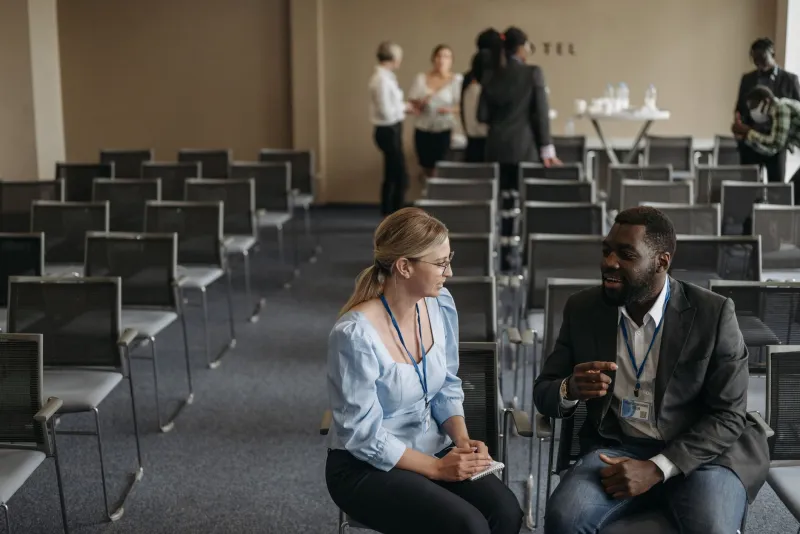
You had the conversation. It felt real. There was laughter, genuine exchange, a moment or two where the connection seemed to click into place. You followed up the next day with a thoughtful note, and the response was warm but brief. A week later, you encounter the same person at another event and watch their eyes flicker with the faint, unmistakable hesitation of someone who cannot quite place you.
You were not forgettable. And yet, you were forgotten.
This experience is more common in elite social and professional communities than most people acknowledge, and its causes are almost never what the people who experience it assume.
The Memory Encoding Problem
Human memory does not record experiences the way a camera does. It encodes them selectively, prioritizing emotional distinctiveness, narrative coherence, and sensory specificity over the sheer quality of an interaction. What this means, in practical terms, is that a technically excellent conversation can leave almost no retrievable trace if it lacks the specific elements that memory uses as anchors.
Cognitive psychologists refer to this as the encoding specificity principle—the idea that memories are most accessible when the conditions of retrieval match the conditions of encoding. When you meet someone at a professional networking event, you are one of perhaps a dozen new faces they encountered that evening. Each conversation, however engaging, is competing for the same limited encoding bandwidth. The people who survive that competition are not necessarily the most impressive. They are the most distinct.
This is the first critical insight: being memorable is not a function of quality. It is a function of differentiation.
The Credential Paradox
High-achievers in curated communities tend to make a specific and understandable error when meeting new people: they lead with their most polished material. The impressive title. The well-rehearsed origin story. The credentials that have, in other contexts, reliably opened doors.
The paradox is that in rooms populated by other high-achievers, this approach actively undermines memorability. When everyone in the room has an impressive title and a well-rehearsed origin story, the polished version of you becomes indistinguishable from the polished version of everyone else. You do not stand out. You blend in—not with the ordinary, but with the extraordinary, which produces the same net result.
Research on social cognition supports this counterintuitive finding. Studies on person memory consistently show that people are more likely to remember individuals who violated their expectations in some way—not through eccentricity or spectacle, but through unexpected specificity or genuine candor. The person who admits a professional failure. The expert who asks a naive question. The accomplished professional who expresses genuine uncertainty about something within their own domain.
These moments are cognitively sticky in a way that polished presentations simply are not.
The Specificity Principle
Within the context of elite communities, the most reliably unforgettable people share a specific quality: they are precise. Not vague. Not broad. Precise.
Rather than describing themselves in category terms—"I work in venture capital" or "I'm in healthcare innovation"—they offer a detail so particular that it creates an involuntary mental image. "I spent three years trying to understand why the most promising early-stage companies in the Midwest keep choosing the wrong first hire" is not a credential. It is a story. And stories, unlike credentials, are what memory is designed to retain.
This principle applies equally to the questions you ask. Generic questions—"What are you working on these days?" or "How did you get into your field?"—are conversationally adequate but cognitively unremarkable. Specific, curious questions—ones that suggest you have genuinely engaged with something the other person said rather than simply waited for your turn to speak—create a very different kind of impression. They signal that the conversation was real, and real conversations are remembered.
Strategic Vulnerability as a Memory Device
There is a meaningful distinction between vulnerability as performance and vulnerability as precision. The former is a social strategy that most sophisticated people can identify and are rightly skeptical of. The latter is something different: the deliberate choice to share something specific and genuine that reveals the texture of your actual experience rather than the surface of your professional identity.
In the high-caliber social environments that Koume Club is designed to cultivate, strategic vulnerability of this kind is not a risk. It is a differentiator. When you share something real—a genuine uncertainty, a question you cannot yet answer, a professional transition that has not yet resolved itself—you give the other person something to hold onto. Something to think about after the event ends and the business cards are filed away.
You also give them something more valuable than a memory: you give them a reason to be curious about you. And curiosity, unlike admiration, is self-sustaining. It motivates follow-up. It motivates introduction. It motivates the kind of ongoing engagement that transforms a single meeting into an actual relationship.
What Unforgettable Actually Looks Like
It is worth being direct about what this framework does not recommend. It does not suggest manufacturing drama or engineering vulnerability for effect. It does not suggest abandoning the professional credibility you have legitimately earned. And it does not suggest that every conversation needs to be an exercise in radical self-disclosure.
What it does suggest is that in rooms full of exceptional people, the path to being remembered runs directly through the willingness to be specific, genuine, and occasionally surprising. Not surprising in the way of spectacle, but surprising in the way of authenticity—the quiet shock of encountering someone in a professional context who seems to actually be present, actually curious, and actually willing to share something that has not been focus-grouped into safety.
The most memorable people in any elite community are not the ones who performed the best. They are the ones who made you feel, even briefly, that you were in a real conversation rather than a curated exchange. That distinction lives in memory long after the details of anyone's credentials have faded.