The Credential Silence: Why What You Don't Say About Yourself Speaks Loudest in Elite Rooms

Imagine two people entering the same professional gathering. The first, within ninety seconds of any introduction, has mentioned the institution where they earned their graduate degree, the title they hold, and the name of at least one organization that confers immediate recognition. The second offers their name, asks a thoughtful question, and listens. By the end of the evening, which one do people want to speak with again?
If you have spent any meaningful time in rooms populated by genuinely accomplished professionals, you already know the answer. And yet the reflex toward credential-leading introductions persists, even among people who know better—because the anxiety that drives it is not rational. It is social.
The Resume as Security Blanket
Credentials serve a legitimate function. They compress complex information about competence into recognizable shorthand. A medical license, a bar passage, a degree from a particular institution—these markers exist because evaluating expertise from scratch is expensive and time-consuming. In transactional contexts, where speed matters and stakes are high, credentials earn their place in the conversation.
But professional communities—especially those built around peer connection, intellectual exchange, and long-term relationship development—are not transactional contexts. They operate by different social physics. And in those environments, leading with credentials does something that most people do not anticipate: it narrows the conversation before it begins.
When you announce your title or institutional affiliation within the first moments of meeting someone, you are not opening a door. You are drawing a map. You are telling the other person exactly which version of you they are permitted to engage with, which questions are relevant, and which aspects of your experience fall outside the defined territory. You have made yourself legible at the cost of making yourself interesting.
Dr. Alison Wood Brooks, a behavioral scientist at Harvard Business School who studies conversation dynamics, has found in her research that people who ask more questions during initial interactions are rated as more likeable and more competent by their conversation partners—regardless of what they actually disclosed about themselves. The implication is significant: in high-stakes social environments, curiosity is a stronger credential than credentials.
What Discerning Communities Actually Reward
At Koume Club, a pattern emerges consistently among members who build the most durable professional relationships: they are not the ones who arrive with the most impressive résumé talking points. They are the ones who create the experience of being genuinely heard.
This is not accidental. Communities populated by high-achievers are, by definition, populated by people who have heard impressive credentials before. They are, in many cases, fatigued by résumé-leading interactions—not because achievement is unimportant, but because it has become the default register of conversation, and defaults are boring. When everyone in the room has a compelling professional story, the story itself stops being a differentiator. The way you tell it—or choose not to tell it—becomes the actual signal.
What discerning communities reward is not the suppression of accomplishment. It is the confidence that comes from not needing to announce it. There is a particular quality of presence that belongs to people who are comfortable being unknown for a few minutes—who can sit in the uncertainty of an unestablished introduction without reaching for their credentials as a life raft. That quality reads, to experienced observers, as authority.
The Curiosity Premium
One of the more counterintuitive findings in research on first impressions is that people who disclose less about themselves early in an interaction are often perceived as more substantive than those who disclose more. This is partly a function of mystery—the human mind is drawn toward incompleteness—but it is also a function of attention. Someone who is busy introducing themselves is not listening. Someone who is listening is, almost by definition, more interesting to be around.
This dynamic has particular relevance in professional communities where the social norm is credential exchange. When everyone is presenting their most polished professional summary, the person who departs from that script—who asks a specific, well-considered question instead of offering a rehearsed answer—immediately distinguishes themselves. Not through performance, but through the absence of it.
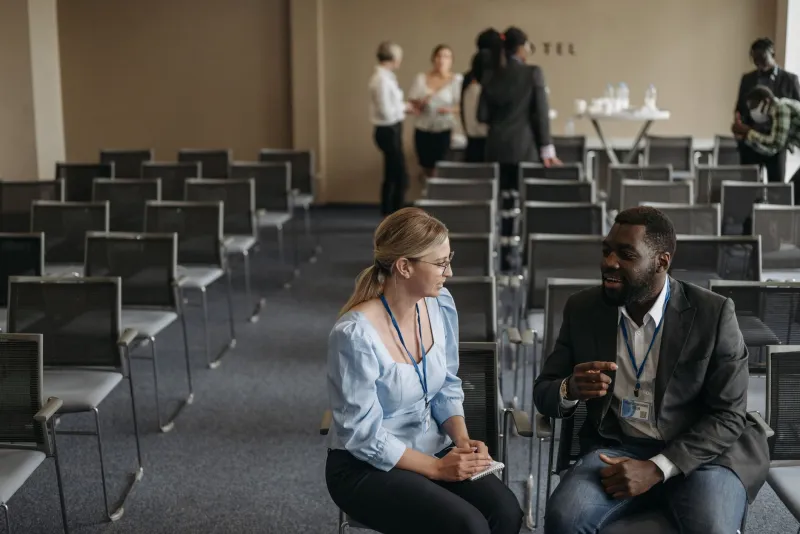
Several members of Koume Club have described experimenting with credential-light introductions at industry events and being struck by the quality of conversations that followed. One member, a senior executive with an objectively impressive professional history, described attending a leadership conference and introducing himself simply by his first name and a genuine question about what had brought the other person to the event. The conversation that followed, he noted, covered territory that credential-first introductions rarely reach: values, uncertainty, the parts of the work that are actually difficult. He left with two relationships that have since become professionally significant. He left previous conferences, where he led with his title, with a stack of business cards and little else.
A Practical Recalibration
None of this is an argument for false modesty or strategic concealment. Credentials, when relevant, belong in conversation. The question is not whether to mention them, but when and how—and whether they are doing the work you think they are doing.
A useful recalibration begins with a single question before any professional introduction: What do I actually want from this conversation? If the honest answer is validation—confirmation that you belong in the room, that your presence is justified—then credential-leading is a symptom of insecurity, not a strategy. If the answer is connection, insight, or the beginning of a meaningful professional relationship, then the most direct path to that outcome is almost never a summary of your résumé.
Consider instead beginning with something true that is not a credential: a genuine observation about the event, a specific question prompted by something the other person said, an honest admission of what you are still figuring out. These openings are more vulnerable, which is precisely why they are more powerful. They signal that you are present as a person, not as a professional profile.
Credibility Beyond Credentials
The most credible people in any discerning community share a quality that cannot be listed on a résumé: they make others feel that the conversation matters. They ask questions that demonstrate they have been paying attention. They remember details. They follow up. They are, in the fullest sense, interested—and that interest, more than any institutional affiliation or title, is what earns them the rooms they inhabit.
Credentials may open doors. But it is character—expressed through curiosity, generosity, and the willingness to be genuinely present—that determines whether you are invited to stay.